This event is in the past. Check out current events here.
Demo
Society & Culture
2026
Event Ended
Understanding Polarization and Filter Bubbles in Social Media: An Interactive Simulation of Personalized Platforms
01.07.2026
|
17:00
-
18:00
h
FAU Schöller Endowed Chair for Information Systems (4th floor)
|
Fürther Straße
248,
90429
Nürnberg
Loading...
Language:
German
In public discourse, social media is often associated with various societal effects. It is said to influence political opinions, contribute to radicalization, and affect election outcomes. At the same time, however, social media is also regarded as an important space for political participation and mobilization, as well as for raising the profile of viewpoints that receive less attention elsewhere. Opinions also vary widely on how strictly platforms should be regulated. While these perspectives each address part of the truth, none of them explain how the observed effects actually occur. Consequently, it often remains unclear how increased visibility of content, intensified debates, and solidified positions emerge from individual decisions.
Such effects can only be understood by examining the systemic interplay of the underlying mechanisms. Platforms, content, algorithmic selection mechanisms, and user behavior influence one another and are constantly changing. Platforms optimize for interaction and dwell time, content is designed accordingly, and users react to what is displayed. These reactions feed into the next selection process and influence what will be visible in the future. These interactions create feedback loops that reinforce themselves and favor certain content or perspectives. In our research on digital platforms, we examine these interactions, analyzing under what conditions such dynamics stabilize or change and the role different incentive structures play in this process. To make these connections understandable, we have developed an interactive simulation game.
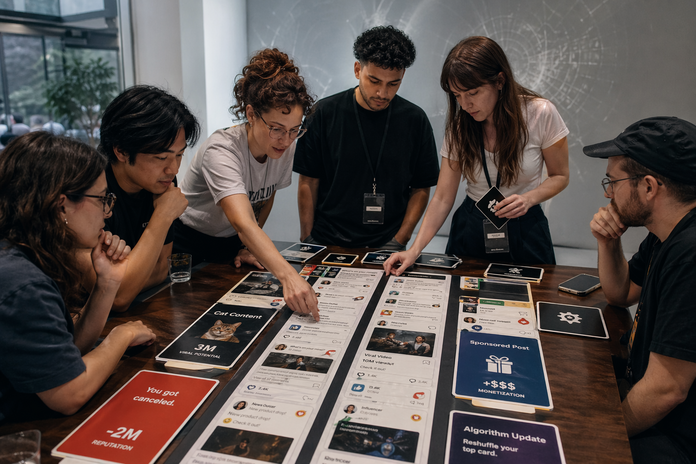
In our simulation game, participants assume different roles on a platform and make decisions from their respective perspectives. While the format is particularly aimed at young people who are familiar with such mechanisms from their own experience, it is also open to anyone who wants to understand how social media works. Each round determines what content is created, how it is prioritized, and which target audiences are addressed. Content creators compete for attention, advertisers place their messages, and platform operators decide which content appears in the feed. Users react to this selection, which shifts what receives attention in the next step. This process reveals how different interests, power dynamics, and incentive structures interact, as well as the actual scope of individual roles. This perspective makes it possible to understand and contextualize common assumptions about the impact of social media.
As the game progresses, certain patterns emerge from these interdependent decisions. Content gains traction because it sparks interaction. Topics rise to the forefront when similar content appears repeatedly. Positions solidify when feedback predominantly comes from comparable perspectives. These patterns do not result from individual decisions, but rather from how the various roles and goals interlock. The dynamics that emerge in the game are subsequently evaluated collectively, revealing how power and incentive structures shape visible outcomes and the conditions under which comparable patterns emerge in real-world platform environments. Based on this, the processes experienced in the game can be systematically categorized and applied to real-world contexts.
Recommended for: people in the fields of education, academia, media and communications, as well as politics and public opinion-forming, and anyone who uses social media, including teenagers and young adults, and wants to understand how platform logic and incentive structures influence the formation of public opinion
Also suitable for:
Teenagers
Students


Hosted by

Friedrich-Alexander-Universität Erlangen-Nürnberg.
Die 1743 gegründete FAU ist mit 40.996 Studierenden eine der großen Forschungsuniversitäten Deutschlands.
Laura Kneppe
laura.kneppe@fau.deUnderstanding Polarization and Filter Bubbles in Social Media: An Interactive Simulation of Personalized Platforms
01.07.2026
|
17:00
-
18:00
h
FAU Schöller Endowed Chair for Information Systems (4th floor)
|
Fürther Straße
248,
90429
Nürnberg
Event Ended