Feminist AI: Why AI Is a Question of Power and Control
Published on February 19, 2026
.png?locale=en)
Artificial intelligence is rapidly transforming the economy and society, largely driven by a handful of major tech corporations. While efficiency and innovation take center stage, issues of power and inequities often get pushed aside. With the release of her book “Feminist AI” we spoke with Eva Gengler about these very questions: Who shapes AI? Who benefits from it — and who doesn’t?
Picture: © Helena Henkel
Picture: © Helena Henkel
As a researcher in business information systems, Eva Gengler concentrates on the overlap between power and artificial intelligence. Her focus goes beyond the tech itself to the structures in which it is developed and the power dynamics embedded within them.
“I am not developing ‘the one’ feminist AI. I am trying to develop an approach that makes it possible to design and use all AI systems in a more feminist way.”
For her, feminist AI is not a standalone product but a practice and the mentality behind it. A shift in perspective from pure optimization to responsibility, representation, and equity. Technology should not only be more capable, but more thoughtfully designed.
“So it’s not about a single ‘marvel of technology,’ but about a fundamental change in the way we think about, design, and use AI.”
AI is a question of power
For Eva, the core issue isn’t a few isolated missteps — it’s the system as a whole. AI can not be neutral: it’s developed, funded, and deployed within existing power structures.
“Power is central in this system. Who has the power to shape opinions? Who has the power to train large AI systems? Who has access to vast amounts of data? Who has the power to decide how and for what purposes these systems are used?”
These questions are at the heart of her work. Today, AI is primarily developed by actors who already hold significant economic, political, and technological influence. That means they don’t just determine the technical architecture, they also shape its impact on society.
There’s also the issue of resources and dependency, which often gets overlooked in public debates.
“Secondly, these systems consume enormous amounts of resources, contributing to the acceleration of the climate crisis and once again disproportionately affecting vulnerable groups.”
Here power becomes visible again: Who profits economically from AI? And who bears the environmental and social costs? In the end, moving toward feminist AI isn’t just a technical challenge — it’s about recognizing power structures and consciously choosing a different path.
Where changes begin
If AI reinforces inequity and stabilizes existing structures, the inevitable question is: where and how does change begin? For Eva, the biggest leverage point lies in the management of tech corporations. That’s where strategic decisions are made, decisions that go far beyond technical details.
“They decide the purpose of AI, whether data is handled transparently, whether diversity is included in the process, and which priorities are set. If this responsibility is not taken on at that level, then we will not see truly feminist AI systems.”
As long as AI is mainly used to make existing processes more efficient, existing power structures largely remain untouched. From Eva’s perspective, real change means renegotiating the purpose of AI: it should help make systems more just instead of automating inequities. AI is never neutral when it comes to social structures. It can reinforce patterns, ignore them, or intentionally correct them. That’s exactly why management responsibility in AI development is always also a question of power.
Change happens on multiple levels
Even though Eva sees the biggest leverage clearly with tech corporations, responsibility doesn’t stop there. Especially politics can set the right impulses for feminist AI systems, by encouraging smart frameworks and fostering fair developments. But structural shifts can be initiated from multiple directions.
For example, the feministAI Community was created as a platform for exchange and mutual support. And precisely because AI is so heavily shaped by a few major players, these kinds of networks are crucial for bringing perspectives together and creating visibility.
For example, the feministAI Community was created as a platform for exchange and mutual support. And precisely because AI is so heavily shaped by a few major players, these kinds of networks are crucial for bringing perspectives together and creating visibility.
In addition, enableYou works directly with organizations to guide change processes, especially when it comes to distributing power more fairly. This work introduces new ways of thinking and new expertise into companies that need sustainable improvement.
“We should remove barriers to genuine exchange and collaboration on equal footing. And that also includes training our employees in the competent and responsible use of AI.”
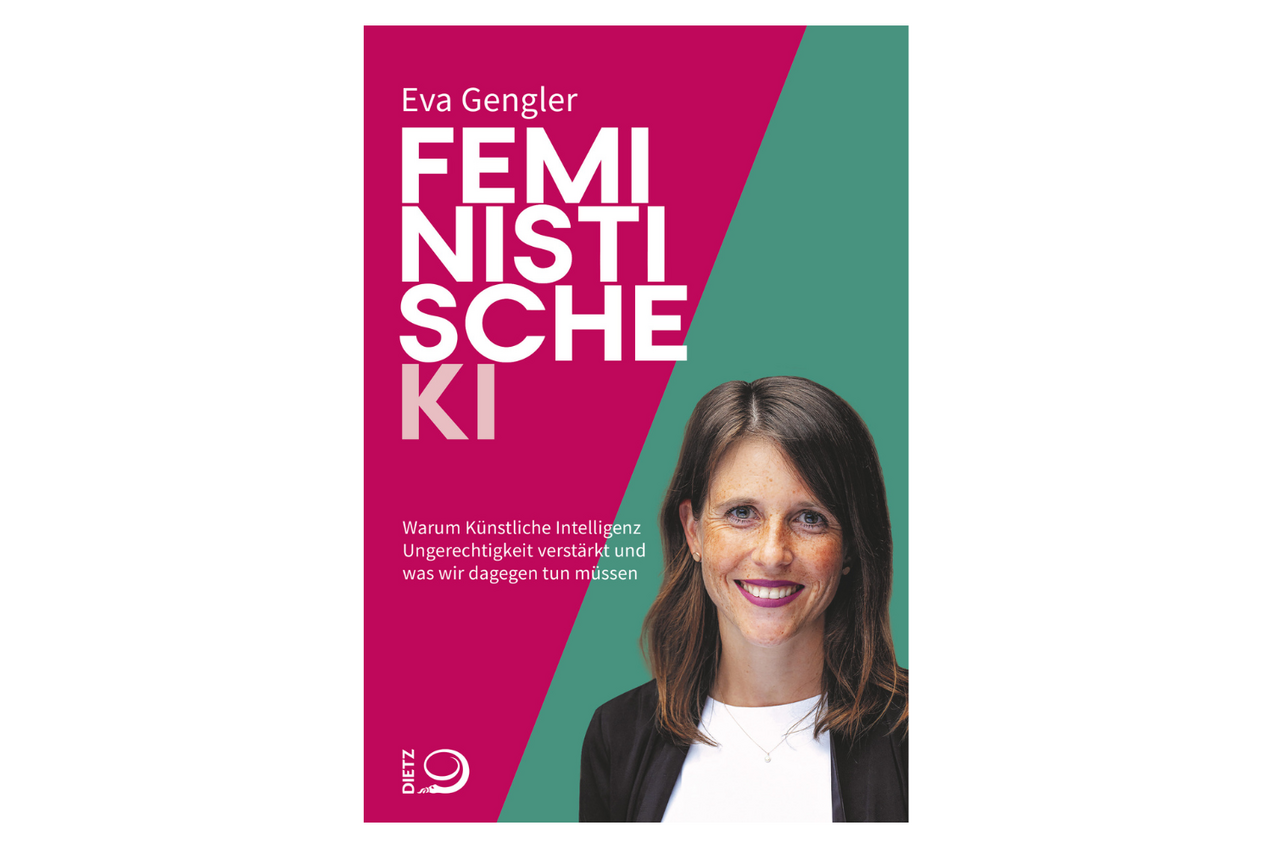
Feminist AI is not an abstract ideal. It becomes visible in processes, decision-making pathways, and everyday interactions with technology. Above all, it needs to be recognized and continuously developed. With her book “Feministische KI” which will be published in early March, Eva is giving feminist AI greater visibility and systematically bringing together the debate around power, structures, and responsibility in digitalization.
A great example of positive change is the support chat “Maya” from myProtectify. It offers emotional support to people who’ve experienced violence. It really shows how technology can be used to create safe spaces and empower marginalized communities.
A great example of positive change is the support chat “Maya” from myProtectify. It offers emotional support to people who’ve experienced violence. It really shows how technology can be used to create safe spaces and empower marginalized communities.
In this way, change happens not only through major strategic decisions but also through ongoing work on structures — within companies, across networks, and in collaboration with politics and society.
Eva Gengler holds a doctorate in economics and social sciences. As a business information systems scholar, she researches and works from an intersectional feminist perspective at the intersection of power and artificial intelligence. She earned her PhD at FAU Erlangen-Nuremberg in the Business and Human Rights program, focusing on AI from a feminist sociotechnical perspective. As a speaker and co-founder of the feminist AI Community and enableYou, she advocates for fair and responsible technology design. She is the author of “Feministische KI".

Alina Laßen
Werkstudentin Marketing & Projektmanagement
NUEDIGITAL
Related Blog Posts

How do you plan a successful event? The 5 most important ...
Johanna and Elwira from the NUEDIGITAL team know the most common pitfalls and share what really makes a difference at an event — from the right image formats to the very first question you should ask yourself.
Published on March 31, 2026
Read more.png?locale=en)
.png?locale=en)
From AI-powered gardening to phone bots: AI HUB Nuremberg...
Andrea Reindel on the AI HUB Nuremberg, AI use cases in gardening and medical practices, and why the project is being extended by two years.
Published on May 08, 2026
Read more