Why digital transformation fails—and how effective organizational development can help
Published on May 26, 2026
.png?locale=en)
Tools aren't the problem
Generative AI is now included in almost every software suite and featured in nearly every pitch deck. Yet when you look at teams’ day-to-day work, there’s surprisingly little evidence of it. Licenses sit unused, and many pilot projects never make it past the slide-show phase.
BlackBox/Open, the Nuremberg-based consulting firm specializing in evidence-based and agile organizational development, has been guiding SMEs, large corporations, and nonprofits through precisely these phases since 2008. In this interview, founder and CEO Dr. Colin Roth explains why the reflex to “buy more tools” so rarely works—and what psychological levers related to work and organizational psychology research offers instead.
BlackBox/Open, the Nuremberg-based consulting firm specializing in evidence-based and agile organizational development, has been guiding SMEs, large corporations, and nonprofits through precisely these phases since 2008. In this interview, founder and CEO Dr. Colin Roth explains why the reflex to “buy more tools” so rarely works—and what psychological levers related to work and organizational psychology research offers instead.
The adoption gap: Pioneers take the lead, while the rest watches
During the conversation, an observation from consulting practice quickly comes up: In most organizations, generative AI is driven by a small group, while the rest stand on the sidelines.
“The use of generative AI is currently concentrated among those who are digital pioneers anyway. Companies should provide their employees with the framework to develop proactivity.”
Often, this even leads to shadow IT: employees who secretly use ChatGPT or run external tools in their browsers. From a compliance perspective, this is undoubtedly a problem at first glance. At the same time, however, it’s also a signal that an organization would be wise not to ignore.
“You won’t be able to stop it—you need to capture it, categorize it, structure it, and build the framework.”
BlackBox/Open recommends viewing shadow IT for what it usually is: an indicator of innovation. Where official AI pathways are lacking, people simply find their own. Instead of imposing blanket bans, the real task of governance is to build secure frameworks where the tools that are already in use can be integrated. This transforms uncontrolled growth into a manageable practice, and silent pioneers become multipliers who can be showcased.
But what the pioneers have lacked so far is a way to bring the rest of the workforce along. This is exactly where the next point in the interview comes in.
When “we” drive the change
But what actually works? In collaboration with FAU Erlangen-Nürnberg and Eindhoven University, BlackBox/Open conducted a study that demonstrated measurable results (Demerouti, Roth, Ebner, Soucek & Moser, 2024): So-called “job crafting training” sessions were held at several companies in the region—training sessions in which employees practice dealing with change proactively. The result was measurable: Those who participate in the training demonstrate stronger innovative behavior. Proactivity and innovation can therefore be cultivated through training.
In practice, this means above all: Employees need a framework for experimentation and permission to do so—permission that is actually communicated in performance reviews, not just in the slide deck vision.
Training alone, however, does not solve the problem. Someone is needed to anchor the change within the group. The second lever that BlackBox/Open highlights in the interview comes from social psychology: Identity Leadership. This refers to a style of leadership that actively fosters the group’s identity rather than merely assigning tasks.
The model rests on four pillars:
In practice, this means above all: Employees need a framework for experimentation and permission to do so—permission that is actually communicated in performance reviews, not just in the slide deck vision.
Training alone, however, does not solve the problem. Someone is needed to anchor the change within the group. The second lever that BlackBox/Open highlights in the interview comes from social psychology: Identity Leadership. This refers to a style of leadership that actively fosters the group’s identity rather than merely assigning tasks.
The model rests on four pillars:
- “Being one of us” describes the leader’s mindset: they see themselves as part of the group, not a step above it.
- “Doing it for us” refers to decisions made in the interest of the group, rather than for personal gain.
- “Crafting a sense of us” is the ongoing, often granular work of building what holds the group together—rituals, shared stories, a common language.
- “Making us matter” makes the group visible—both internally and externally. Celebrating successes, giving feedback, and reassuring the group: You’re on the right track. Not as an annual event, but in everyday life.
“Identity Leadership is identity-building leadership that develops the team as a whole. Developing a sense of ‘we’ is not an event, but a continuous process.”
Historically, this is nothing new, by the way. Major changes usually take hold where a group identifies with the cause. In an interview, the CEO of BlackBox/Open cites the civil rights movement of the 1960s: Martin Luther King was effective not because he addressed individual people, but because he managed to operate from within the heart of the population. This was the case during social upheavals, and when a corporation today wants to embed AI in everyday life, it follows the same logic on a smaller scale.
Here’s how it can work—two examples from Nuremberg’s small and medium-sized businesses and the IGLO model
A hotel in Nuremberg, over 160 years old, in the midst of an industry that is struggling. Management’s response to the pressure wasn’t to introduce new tools. Instead, it was an honest question: Who are we, really, and do housekeeping and the front desk truly work as equals? Management didn’t place itself above the team; it became part of it. “We” became the strategy. Today, they’re keeping their team together while others are looking for new staff.
At a retail company in the Nuremberg harbor, the same principle applies: decisions aren’t pushed through from the top, but made together—in the interest of everyone, not just individuals. Performance management as a bottom-up approach; corporate values don’t come from the ad agency, but from the workforce. What was bold back then is now part of their DNA.
“Consistent cultural development and participation ensure that mid-sized companies stay ahead of the curve and keep their teams united.”
The takeaway: Neither waited for better tools. They invested in the “we.” That is exactly what Identity Leadership is, and that is exactly what works when change is not imposed but lived.
But how can you make a concrete difference now? The answer lies in four letters: IGLO. Not an off-the-shelf model—but a question on four levels that anyone can ask, whether a developer, workshop manager, or administrative assistant.
I for Individual. When was the last time you rethought your job? Not your title, but the way you work. COVID-19 has shown what we’re capable of when we have no choice. The question is: Why are we waiting for the next crisis?
G for Group. Who are we? What are our goals, and how do we work? Team reflexivity doesn’t start with a workshop, but with the question: Are we still doing this right?
L for Leadership. Leadership isn’t a job description. Anyone who mentors a new colleague, drives a project forward, or launches an initiative takes on leadership responsibility and thereby relieves the very people who are supposed to be thinking strategically.
O for Organization. Energy in a company is either palpable or it isn’t. Those who take on shared responsibility for the organizational climate gain more for themselves: greater control, less stress, better health. This is scientifically proven.
Transformation doesn’t wait for management. It begins when individuals stop waiting.
At a retail company in the Nuremberg harbor, the same principle applies: decisions aren’t pushed through from the top, but made together—in the interest of everyone, not just individuals. Performance management as a bottom-up approach; corporate values don’t come from the ad agency, but from the workforce. What was bold back then is now part of their DNA.
“Consistent cultural development and participation ensure that mid-sized companies stay ahead of the curve and keep their teams united.”
The takeaway: Neither waited for better tools. They invested in the “we.” That is exactly what Identity Leadership is, and that is exactly what works when change is not imposed but lived.
But how can you make a concrete difference now? The answer lies in four letters: IGLO. Not an off-the-shelf model—but a question on four levels that anyone can ask, whether a developer, workshop manager, or administrative assistant.
I for Individual. When was the last time you rethought your job? Not your title, but the way you work. COVID-19 has shown what we’re capable of when we have no choice. The question is: Why are we waiting for the next crisis?
G for Group. Who are we? What are our goals, and how do we work? Team reflexivity doesn’t start with a workshop, but with the question: Are we still doing this right?
L for Leadership. Leadership isn’t a job description. Anyone who mentors a new colleague, drives a project forward, or launches an initiative takes on leadership responsibility and thereby relieves the very people who are supposed to be thinking strategically.
O for Organization. Energy in a company is either palpable or it isn’t. Those who take on shared responsibility for the organizational climate gain more for themselves: greater control, less stress, better health. This is scientifically proven.
Transformation doesn’t wait for management. It begins when individuals stop waiting.
.png?locale=en)
Does culture swallow strategy? Wrong question.
“Culture eats strategy for breakfast … a bit of an exaggeration, because for me, strategy is also corporate culture.”
In BlackBox/Open’s view, strategy and culture are not two opposing poles, but rather parts of the same process. Where vision, commitment, and a willingness to learn are lacking, even the best strategy won’t succeed. Where leadership isn’t visibly behind the change, it fizzles out at the middle management level—exactly where change is supposed to happen. The recommendation from the interview: ambidexterity. Keep day-to-day operations running smoothly while simultaneously working on the future—with both hands. OKR cascades passed down top-down across four levels are not an agile approach, but rather Management by Objectives with a new label. And whoever cuts the budget for Learning & Development first during a crisis is systematically cutting away at their own future.
BlackBox/Open – Open the Black Box, change practice
BlackBox/Open operates precisely at this intersection: between scientific knowledge and business practice. Headquartered at Steinstraße 21 in Nuremberg and with an office in Munich, the firm has been evidence-based since 2008—conducting its own studies in collaboration with FAU, offering executive training, and hosting events such as the CoCreationExpo, where Identity Leadership can be experienced firsthand. The name says it all: opening the black box between research and practice.
This topic belongs on big stages—and just as much in small circles. At the Executive Dinner on June 24, 2026, organizational development in the context of AI will be discussed among managing directors from the region, as part of the Nuremberg Digital Festival. BlackBox/Open is extending an invitation and helping to shape the program. There is deliberately no open registration; anyone familiar with the festival knows: evenings like these are more about ensuring that day-to-day business doesn’t get in the way.
This topic belongs on big stages—and just as much in small circles. At the Executive Dinner on June 24, 2026, organizational development in the context of AI will be discussed among managing directors from the region, as part of the Nuremberg Digital Festival. BlackBox/Open is extending an invitation and helping to shape the program. There is deliberately no open registration; anyone familiar with the festival knows: evenings like these are more about ensuring that day-to-day business doesn’t get in the way.
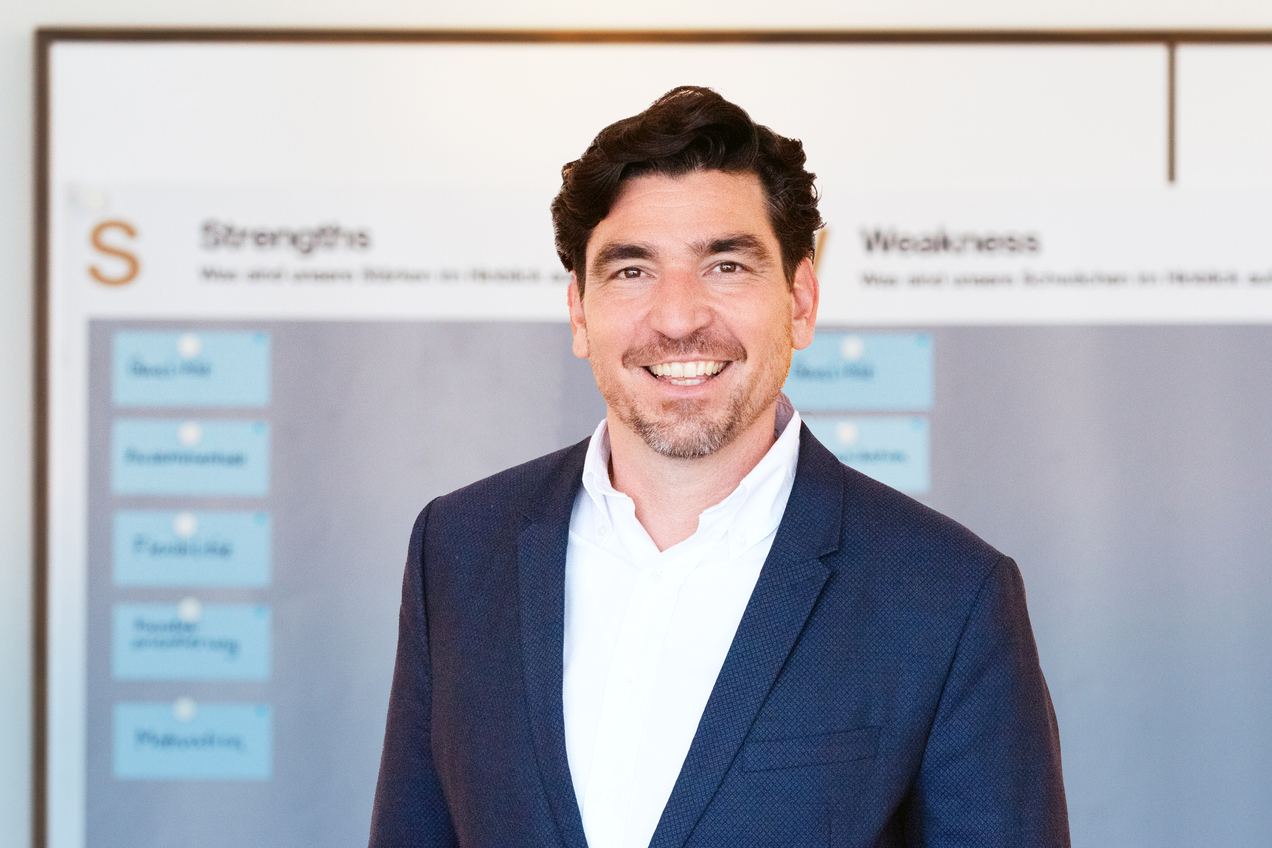
Our interviewee: Dr. Colin Roth
Colin Roth is the founder and CEO of BlackBox/Open, as well as an industrial and social psychologist with over 20 years of experience in executive coaching, training, and evidence-based organizational development. He is a co-founder of ProMES-ICC, trains ProMES® and OKR Facilitators® worldwide, and is a member of organizations including SIOP, EAWOP, and DGPs, as well as co-editor of “EWOP inPractice.” Colin’s mission with BlackBox/Open is to translate the most important findings of evidence-based research into practice, thereby shaping organizational and human resource development in a truly sustainable way. As a pioneer in Identity Leadership with decades of consulting experience, he is one of the most sought-after experts in executive development.
Translated with DeepL.com (free version)
Translated with DeepL.com (free version)
Frequent questions
Why do AI projects in companies fail so often?
The most common cause is not technical, but organizational: adoption fails to take hold because tools are introduced
without taking into account culture, proactivity, and support from top management. Licenses are no substitute for identity work.
What is Identity Leadership—and why now?
Identity Leadership is a leadership approach rooted in social psychology. Instead of leading through power or charisma, the leader actively helps shape the group’s sense of unity. Four principles structure the approach: “Being one of us,” “Doing it for us,” “Crafting a sense of us,” and “Making us matter.” For AI transformations, the approach is relevant because change without a collective identity at the middle management level fizzles out.
Should shadow IT be banned in companies?
BlackBox/Open recommends a different approach: capture it, categorize it, and establish a framework. Shadow IT is usually a sign that official channels are lacking. Blanket bans stifle innovation and
compliance awareness at the same time.
Where is BlackBox/Open located, and what services do they offer?
BlackBox/Open is headquartered at Steinstraße 21 in Nuremberg and has an office in Munich. The work and
organizational psychology consulting firm has been working in an evidence-based manner since 2008 in the fields of transformation, continuing education, and co-creation—with its own studies, training programs, and events such as the CoCreationExpo at the Hammerhof Academy.
The most common cause is not technical, but organizational: adoption fails to take hold because tools are introduced
without taking into account culture, proactivity, and support from top management. Licenses are no substitute for identity work.
What is Identity Leadership—and why now?
Identity Leadership is a leadership approach rooted in social psychology. Instead of leading through power or charisma, the leader actively helps shape the group’s sense of unity. Four principles structure the approach: “Being one of us,” “Doing it for us,” “Crafting a sense of us,” and “Making us matter.” For AI transformations, the approach is relevant because change without a collective identity at the middle management level fizzles out.
Should shadow IT be banned in companies?
BlackBox/Open recommends a different approach: capture it, categorize it, and establish a framework. Shadow IT is usually a sign that official channels are lacking. Blanket bans stifle innovation and
compliance awareness at the same time.
Where is BlackBox/Open located, and what services do they offer?
BlackBox/Open is headquartered at Steinstraße 21 in Nuremberg and has an office in Munich. The work and
organizational psychology consulting firm has been working in an evidence-based manner since 2008 in the fields of transformation, continuing education, and co-creation—with its own studies, training programs, and events such as the CoCreationExpo at the Hammerhof Academy.
.png?locale=en)
Svenja Sorger
Marketing, Projektorganisation
Nürnberg Digital Festival
Related Blog Posts

How do you plan a successful event? The 5 most important ...
Johanna and Elwira from the NUEDIGITAL team know the most common pitfalls and share what really makes a difference at an event — from the right image formats to the very first question you should ask yourself.
Published on March 31, 2026
Read more.png?locale=en)
From AI-powered gardening to phone bots: AI HUB Nuremberg...
Andrea Reindel on the AI HUB Nuremberg, AI use cases in gardening and medical practices, and why the project is being extended by two years.
Published on May 08, 2026
Read more.png?locale=en)
