Kulturatlas Bavaria: A New Hub for People in the Arts"
Published on December 10, 2025
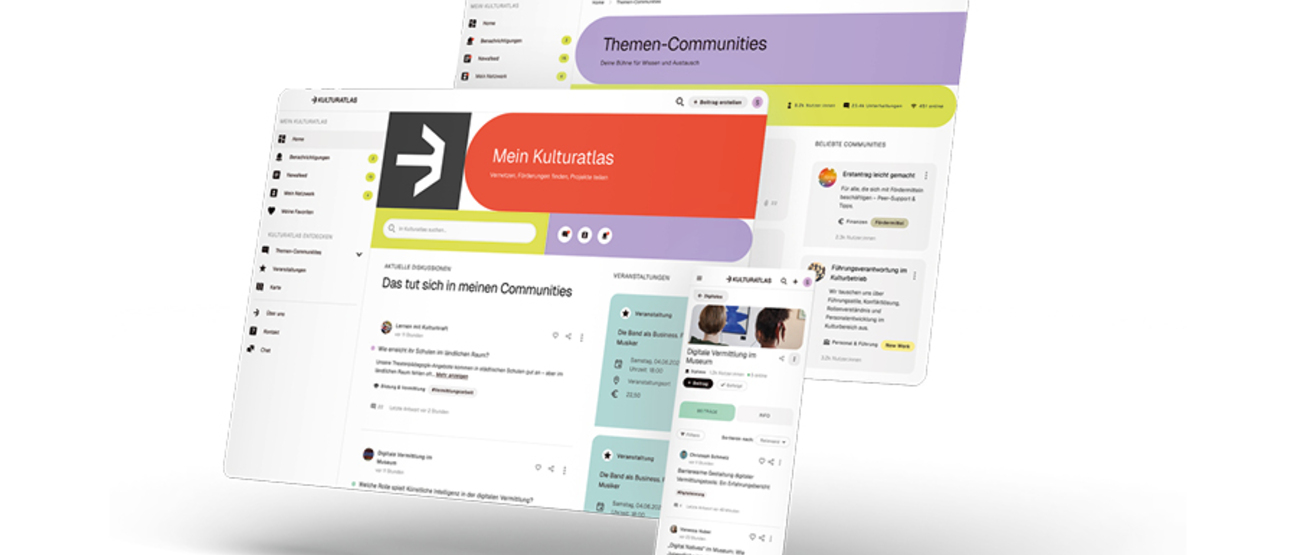
In 2022, the Kulturzukunft Bayern initiative gave rise to a citizen-led movement of over 16,000 people actively involved in more than 35 nonprofit support associations for cultural institutions across Bavaria. From this, the Kulturzukunft Bayern Foundation was established with the goal of ensuring the long-term sustainability of culture in Bavaria.
One of the foundation’s key projects is the Kulturatlas Bayern – a digital platform that increases visibility for artists, initiatives, and projects, facilitates networking, and offers practical tools and support.
In a conversation with Rebecca Zimmermann, who has served as executive director of the Kulturzukunft Bayern Foundation since July 2024, she explains why such digital infrastructure is especially crucial now:
“Bavaria has an incredibly diverse cultural landscape, but for a long time, there was no shared overview: Who’s doing what? Where is culture happening? And how can cultural creators connect more easily?”
Visability through digital structures
The idea for the Kulturatlas Bayern was born out of a clear gap: there was a lack of transparency around who is engaged in cultural work, where it takes place, and how professionals across different disciplines can connect.
“The Kulturatlas emerged from a very practical need – to finally make this knowledge visible and accessible: for cultural professionals, for policymakers and administrators, and also for the general public.”
Developing sustainable cultural funding requires reliable data and systematic networking. “Without trustworthy data and cross-sector networking,” says Rebecca, “we cannot improve funding structures or strengthen culture in all regions in a lasting way.”
Digital tools as a foundation for cultural participation
In a geographically expansive state like Bavaria, digitalization means far more than just increased efficiency—it opens up new possibilities for visibility and collaboration.
“Digitalization gives us the opportunity to transcend regional boundaries. It brings cultural spaces in rural areas into view, connects people who otherwise might never meet, and creates transparency around needs and potential.”
Digital tools enable long-term planning, foster partnerships, and help pool scarce resources. “Digital tools are becoming a critical issue for the future,” says Rebecca, “because they help us consolidate resources, build partnerships, and make cultural work more predictable and sustainable.” This is especially crucial for rural areas: “In rural regions, distances are long, structures are fragmented, and much of the cultural activity goes unseen. Digital platforms provide visibility and connect people who might otherwise work in isolation or struggle to reach audiences."
A Tool for Everyone Who Makes Culture Happen
The Kulturatlas is designed as a digital infrastructure for all those actively shaping cultural life in Bavaria—whether independent artists, grassroots initiatives, municipal institutions, funders, or public cultural administrations. “The Kulturatlas is for everyone involved in creating, supporting, and enabling culture: cultural professionals, associations, independent initiatives, institutions, municipalities, cultural departments, funding bodies, educational organizations, and other partners,” says Rebecca Zimmermann.
The platform will launch in a basic version at the end of January 2026, with the full version—featuring all planned functions—scheduled for release one year later. At its core, the platform offers a user-friendly structure that helps cultural actors quickly find relevant information, identify suitable funding opportunities, connect with potential partners, and share knowledge from real-world practice. The goal is not only to connect projects, but to connect people—across disciplines and beyond regional boundaries.
Crucially, the Kulturatlas is not aimed at the general public. It is a specialized tool for those working behind the scenes to make culture possible. Public visibility will be created through planned integrations with external platforms such as BayernAtlas and BayernCloud, ensuring that cultural offerings appear where audiences are already searching.
Culture Meets Tech: Building the Kulturatlas Together
The Kulturatlas is meant to be an open, growing platform—and its success depends on people from both the cultural and tech worlds coming together. Rebecca Zimmermann urges people in the cultural field to take part:
“Sign up, share your info and experience, find partners, check out funding options, connect, and help shape the Kulturatlas—so it really reflects the diversity of cultural life on the ground.”
And for the tech side, involvement is just as important: “We need your skills—think about interfaces, support data-driven thinking, and help design digital tools that are actually easy to use and inclusive.” Her main message: “We have to build solutions with the cultural sector, not just for it—so that tools truly meet the real, day-to-day needs of those working in culture.”

Rebecca Zimmermann has served as Executive Director of the Kulturzukunft Bayern Foundation since July 2024. Prior to this role, she led the Development Department at the Konzerthaus Dortmund, where she was responsible for strategic cultural development processes and the organization’s sustainability agenda—including the Green Culture Initiative Dortmund, a cross-disciplinary program she initiated. Earlier in her career, she worked with the Rheingau Music Festival, where she played a key role in advancing the organization’s friends association.
In addition to her professional responsibilities, she is actively committed to structural change in the cultural sector. She is a co-founder of alma – Alliance of Leaders in Music & Arts and serves on the Advisory Board of the community music collective Paper Lantern. Rebecca holds a Master’s degree in Music Mediation and Music Management, as well as a Diploma in Music Education.
Photo: © Magdalena Jooss
Photo: © Magdalena Jooss

Alina Laßen
Werkstudentin Marketing & Projektmanagement
NUEDIGITAL
Related Blog Posts


Program Update | As of May 20, 2025
The program of NUEDIGITAL 2025 is live since May 6 - its continuously getting more packed, more exiting and more vibrant! Discover now the latest Events that joined the festival program.
Published on May 20, 2025
Read more.jpg?locale=en)
Creativity means breaking the rules – Henning Beck on thi...
In the digital age, we get hit with new info every second. Neuroscientist and author Dr. Henning Beck explains in an interview why it actually makes sense to hand off some thinking to tools, why AI isn’t necessarily 'smarter,' and why breaking the rules on purpose might just become the most important skill of the future.
Published on October 15, 2025
Read more